
Blogs
Supreme Court narrows FAAAA preemption for transportation brokers
5/21/26
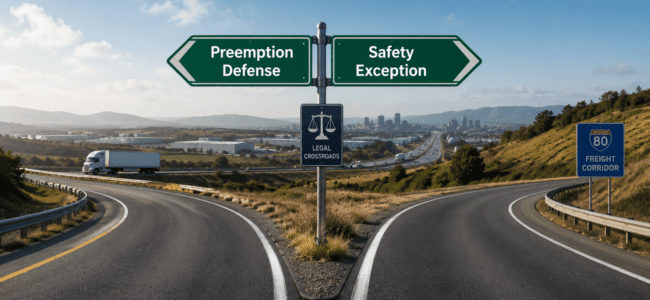
The Supreme Court has closed a major preemption door for transportation brokers. In Montgomery v. Caribe Transport II, LLC (May 14, 2026), the Court held that the Federal Aviation Administration Authorization Act does not categorically preempt state-law negligent-selection claims against brokers when the claim is tied to motor-vehicle safety.
The case arose from a serious truck crash. C.H. Robinson, acting as a broker, arranged for Caribe Transport to haul a load of plastic pots through Illinois. Caribe’s driver struck the plaintiff’s tractor-trailer, causing severe and permanent injuries. The plaintiff alleged that C.H. Robinson negligently selected Caribe because Caribe had a “conditional” FMCSA safety rating and alleged deficiencies involving driver qualifications, hours of service, maintenance, and crash rate.
The broker’s defense was preemption. The FAAAA broadly preempts state laws related to a broker’s or motor carrier’s “prices, routes, or services” “with respect to the transportation of property.” But Congress included an important carveout: the statute does not restrict “the safety regulatory authority of a State with respect to motor vehicles.”
That safety exception carried the day
Justice Barrett, writing for a unanimous Court, assumed, without deciding, that the negligent-selection claim would otherwise fall within the FAAAA’s preemption clause. The question was whether the safety exception saved it. The Court held that it did. Common-law duties are part of a State’s safety-regulatory authority, and a negligent-hiring claim imposes a duty of reasonable care when selecting a contractor for work that risks physical harm.
The key phrase was “with respect to motor vehicles.” The Court gave that phrase its ordinary meaning: concerning or regarding motor vehicles. From there, the analysis was straightforward. A claim that a broker negligently selected an unsafe carrier to move goods by truck concerns the trucks that will do the moving. That is enough to bring the claim within the FAAAA’s safety exception.
The Court rejected the broker’s floodgates argument. The safety exception does not save every claim touching broker services. It saves only claims involving motor-vehicle safety. State economic regulation—rates, routes, pricing, and non-safety service rules—remains preempted.
The Court also declined to let a statutory anomaly do the broker’s work. C.H. Robinson argued that another FAAAA provision addressing intrastate broker regulation lacks a safety exception, suggesting that brokers should be excluded from the interstate safety exception too. The Court acknowledged the oddity but refused to rewrite the text. Whatever the mystery in the statutory scheme, the alleged negligent selection of an unsafe motor carrier whose truck caused injury fit comfortably within state safety authority “with respect to motor vehicles.”
Justice Kavanaugh, joined by Justice Alito, wrote separately to stress that the case was “closer than the Court’s opinion perhaps might suggest.” That concurrence may prove useful for brokers and their counsel going forward. Kavanaugh recognized that brokers do not own the trucks, lease the trucks, or hire the drivers. He also acknowledged the practical costs of increased litigation, insurance, and carrier-vetting burdens.
But those concerns did not change the result. In Kavanaugh’s view, Congress enacted the FAAAA to deregulate the trucking industry economically—not to strip away safety accountability. And because federal law imposes little meaningful safety regulation on brokers’ carrier-selection decisions, a broad preemption rule would risk leaving broker selection in a regulatory “black-hole.”
What this means for brokers
For brokers, Montgomery is a significant blow. FAAAA preemption is no longer a reliable early exit in negligent-selection cases arising from truck crashes. If the plaintiff’s theory is that the broker selected an unsafe carrier and that selection contributed to a motor-vehicle accident, the claim will likely survive a preemption challenge.
But the decision does not make brokers insurers of every carrier they select. That distinction matters. Kavanaugh expressly noted that brokers should be able to defeat claims when they act reasonably and arrange transportation with reputable carriers. He also pointed to proximate cause as an important limiting principle.
The practical takeaway is simple: brokers need a defensible carrier-selection process, and they need records showing they followed it. That means documenting what safety information was reviewed, what red flags existed or did not exist, why the carrier was selected, and whether the broker had any reason to believe the carrier posed an unreasonable safety risk.
For defense counsel, Montgomery changes the motion practice. The better arguments will focus on what the broker actually knew, what it reasonably could have known, whether the carrier was properly registered and apparently reputable, whether any alleged safety issue had a causal connection to the crash, and whether the plaintiff is trying to convert a broker into a guarantor of carrier safety.
For more information on this topic contact Robert Scavone Jr. at robert.scavone@fmglaw.com or your local FMG attorney.
Information conveyed herein should not be construed as legal advice or represent any specific or binding policy or procedure of any organization. Information provided is for educational purposes only. These materials are written in a general format and not intended to be advice applicable to any specific circumstance. Legal opinions may vary when based on subtle factual distinctions. All rights reserved. No part of this presentation may be reproduced, published or posted without the written permission of Freeman Mathis & Gary, LLP.
Share
Save Print