
Blogs
More claims, bigger losses, new tech risks: Inside the 2026 Annual Lawyer Professional Liability Survey
6/24/26
By: Mark Sullivan
EPIC Insurance Brokers recently released Eileen Garczynski’s 16th Annual Lawyer’s Professional Liability Claims Survey. Ms. Garczynski is a recognized authority in the field and has been compiling claims data from leading legal malpractice insurers since 2011. The survey, which was published by broker Ames & Gough between 2010 and 2024, tracks trends in the number of claims reported each year, the size of payouts and the practice areas most likely to generate malpractice exposure. Ms. Garczynski was consulted with and provided quotes for this blogpost.
Claim severity and quantity increase for the first time in years
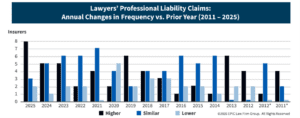
“Eight out of thirteen insurers reported higher claim frequency this year, which is a clear signal that the market has shifted.” – Eileen Garczynski
This year’s survey confirms the stakes of legal malpractice claims continue to rise. Nine of the 13 polled carriers reported reserving at least one claim in excess of $100 million during the last two years, and two reported having paid claims over $100 million in that period. Transactional representations continue to be the most likely source of those outsized losses. Of the 15 nine-figure claims reported by the surveyed carriers, only one appears to have involved litigation. The principal departure from prior years’ trends was claim frequency. Between 2019 and 2024, earlier versions of the survey reflected relatively flat claim volume even as exposure and payouts increased. The 2026 survey is the first in several years to show an increase in both the number of claims and their severity.
Complex transactional claims remain the largest source of exposure
The heavy distribution of claims arising from complex business matters reflects that in periods of economic uncertainty clients may be more inclined to look to their lawyers as another source of recovery for losses tied to failed deals or disappointing investments. Fifty-three percent of carriers identified business transactions as a leading source of claims, while 46 percent listed corporate and securities matters. The clearest high-volume specialty, however, remains trusts and estates: 77 percent of carriers identified it as one of the top three practice areas generating the greatest number of claims. Carriers appear to expect that trend to continue as the United States moves through what is often described as the largest intergenerational wealth transfer in its history.
Claims against insurance defense counsel are here to stay
Claims against insurance defense counsel remain a relatively new but still notable source of exposure, even though the 2026 survey registered a modest decline from 36 percent in 2024 to 23 percent in 2025. It is still significant that any carriers identify insurance defense as a leading source of claims, because no carriers did so from the survey’s inception in 2010 until 2021, when 18 percent first identified it as one of the busiest practice areas generating malpractice claims. Conflicts of interest also remain a particularly important source of exposure and concern for carriers, in part because they can resonate strongly with juries and, at times, judges who may bring their own assumptions about the profession to those allegations.
Technological failures are driving more claims than ever
“The biggest misconception is that AI can replace legal judgment. It can’t—the duty of competence still rests entirely with the lawyer.” – Eileen Garczynski
Technological competence continues to be an area of significant concern for carriers, with uncontrolled use of artificial intelligence and cyber threats identified as the issues keeping legal malpractice insurers “up at night.” Exposure to cyber-related losses is already well established, but until this year’s survey AI had largely been treated as a future risk that carriers expected to confront eventually, but were not yet seeing in meaningful numbers. That appears to have changed. The 2026 survey asked carriers whether they had seen an increase in actual AI-related malpractice claims, and more than half of respondents (seven of 13) reported that they had.
Taken together, the survey depicts a professional liability landscape in which the primary sources of malpractice exposure have remained relatively stable, even as the financial consequences of those claims continue to escalate. Ms. Garczynski summarized the current landscape: “What we’re seeing is a perfect storm: economic volatility, complex transactions and accelerating AI adoption all converging to increase legal risk.”
Business transactions, corporate work, trusts and estates matters and conflicts issues still dominate carriers’ attention, but they now do so against a backdrop of larger reserves, more frequent nine-figure exposures and a renewed increase in overall claim volume. At the same time, newer risks such as AI-related malpractice claims are no longer merely theoretical. Their emergence confirms that technological competence is becoming a core component of malpractice risk, rather than a separate or emerging issue. In short, the 2026 survey shows that law firms are operating in an environment in which both claim frequency and potential loss severity are increasing, making careful client intake, conflicts management, matter supervision and technology controls more important than ever.
For more information on this topic contact Mark Sullivan at mark.sullivan@fmglaw.com.
Information conveyed herein should not be construed as legal advice or represent any specific or binding policy or procedure of any organization. Information provided is for educational purposes only. These materials are written in a general format and not intended to be advice applicable to any specific circumstance. Legal opinions may vary when based on subtle factual distinctions. All rights reserved. No part of this presentation may be reproduced, published or posted without the written permission of Freeman Mathis & Gary, LLP.
Share
Save Print